🏠 Long-Term Care

ElderShield & CareShield Life

Understanding Singapore's long-term care insurance schemes is essential for comprehensive financial planning. Learn how these government schemes work and what supplementary coverage options are available for expats.

What is CareShield Life?

CareShield Life is Singapore's national long-term care insurance scheme that provides basic financial support if you become severely disabled and cannot perform at least 3 of the 6 Activities of Daily Living (ADLs): washing, dressing, feeding, toileting, walking, and transferring.

It replaced ElderShield in 2020 and is mandatory for Singapore Citizens and Permanent Residents born in 1980 or later. The scheme provides lifetime payouts that increase over time, funded by premiums that can be paid using Medisave.

🆕 2026 Enhancement

Effective 2026, the annual payout growth rate will double from 2% to 4%. This means monthly payouts will increase faster. For example, a policyholder claiming in 2030 will receive $806/month (up from the previously projected $731). To support this enhancement, the government is providing over $570 million in subsidies to help mitigate premium increases.

📌 Key Point for Expats

CareShield Life is only available to Singapore Citizens and Permanent Residents. As a foreigner on a work pass, you're not eligible for this scheme. However, there are private long-term care insurance options that can provide similar protection.

CareShield Life at a Glance

Monthly Payout From SGD 600/month
Payout Duration Lifetime
Payout Increase 4% per year (from 2026)
Premium Period Until age 67
Eligibility Citizens & PRs only

ElderShield 300 vs ElderShield 400 vs CareShield Life

Understanding the differences between Singapore's long-term care insurance schemes helps you make informed decisions about your coverage.

📅 Historical Timeline: From ElderShield to CareShield Life

September 2002

ElderShield Launched

ElderShield was introduced as Singapore's first national severe disability insurance scheme, offering ElderShield 300 and ElderShield 400 plans.

October 2020

CareShield Life Launched

CareShield Life replaced ElderShield. ElderShield was closed to new applications from 1 October 2020.

2026 (Upcoming)

Enhanced Payouts

CareShield Life payout growth rate doubles from 2% to 4% per year, significantly increasing lifetime benefits.

1 Born 1979 or Earlier

  • If you had ElderShield, you may remain on ElderShield or opt to join CareShield Life
  • If you never joined ElderShield, you can voluntarily join CareShield Life
  • Switching to CareShield Life is irreversible

2 Born 1980 or Later

  • Automatically enrolled in CareShield Life from age 30
  • Mandatory for all Singapore Citizens and PRs
  • Cannot opt out (except for specific exemptions like severe disability)
Feature ElderShield 300
(Closed Oct 2020)
ElderShield 400
(Closed Oct 2020)
CareShield Life
(Current Scheme)
Scheme Status Closed Closed Active
Monthly Payout Amount $300/month
(Fixed)
$400/month
(Fixed)
From $600/month
(Increasing annually)
Maximum Payout Period 5 years
(60 months max)
6 years
(72 months max)
Lifetime
(As long as severely disabled)
Maximum Total Payout $18,000
($300 × 60 months)
$28,800
($400 × 72 months)
Unlimited
(Lifetime payouts)
Annual Payout Growth ✗ None (Fixed) ✗ None (Fixed) ✓ 2%/year (before 2026)
✓ 4%/year (from 2026)
Coverage Start Age Age 40 Age 40 Age 30
Premium Payment Period Until age 65 Until age 65 Until age 67
Claim Criteria Unable to perform ≥3 of 6 ADLs Unable to perform ≥3 of 6 ADLs Unable to perform ≥3 of 6 ADLs
Eligibility Singapore Citizens & PRs Singapore Citizens & PRs Singapore Citizens & PRs
Mandatory? Optional
(with opt-out option)
Optional
(with opt-out option)
Mandatory
(for those born 1980+)
Medisave Payable ✓ Yes ✓ Yes ✓ Yes
Supplements Available ElderShield Supplements
(existing policies only)
ElderShield Supplements
(existing policies only)
CareShield Life Supplements
(3 approved insurers)
💡

Key Takeaway: Why CareShield Life is Better

  • Lifetime payouts vs. ElderShield's capped 5-6 years (critical since average care duration is 10+ years)
  • Higher starting payout of $600/month (vs $300-$400) that increases annually
  • Earlier coverage from age 30 (vs age 40), providing longer protection
  • Inflation protection with 4% annual growth (from 2026) to keep pace with rising care costs

For ElderShield holders born before 1980: Consider switching to CareShield Life for significantly better benefits. The transition is subsidised by the government.

Payout Comparison Example: 10 Years of Care

300

ElderShield 300

5-year max payout

$18,000

Total lifetime maximum

❌ Payouts stop after 5 years

❌ No inflation protection

400

ElderShield 400

6-year max payout

$28,800

Total lifetime maximum

❌ Payouts stop after 6 years

❌ No inflation protection

RECOMMENDED
600

CareShield Life

Lifetime payout

$100,000+

Over 10 years (with growth)

✓ Payouts continue for life

✓ 4% annual increase (from 2026)

* CareShield Life example assumes 4% annual growth from 2026. Actual amounts depend on claim year and payout growth rate.

How CareShield Life Payout Works

Claim Eligibility

To receive CareShield Life payouts, you must be assessed as severely disabled, meaning you cannot perform at least 3 out of 6 Activities of Daily Living (ADLs):

🚿 Washing
👔 Dressing
🍽️ Feeding
🚽 Toileting
🚶 Walking
🛏️ Transferring

📋 Assessment Process

Disability assessments are conducted by MOH-appointed assessors. Once approved, you'll receive lifetime monthly payouts as long as you remain severely disabled. Payouts continue even if you recover partially. They only stop upon full recovery or death.

Payout Structure (From 2026)

Starting Monthly Payout $600/month

Base payout when you first become eligible

Annual Growth Rate 4% per year

Payouts increase yearly until age 67 (enhanced from 2%)

Example: Claim in 2030 $806/month

Projected payout with 4% annual growth

Payout Duration Lifetime

Continues for life while severely disabled

Payout Illustration: Base vs With Supplement

1

CareShield Life Only

Base government scheme without any supplement

Monthly Payout $600
Annual Payout $7,200
10-Year Total $72,000

⚠️ May not be sufficient for quality nursing home care (avg. $2,500-$4,000/month)

RECOMMENDED
2

With Upgrade

CareShield Life + $2,400/month supplement

Monthly Payout $3,000

$600 (CSHL) + $2,400 (Supplement)

Annual Payout $36,000
10-Year Total $360,000

Sufficient coverage for quality care + peace of mind for family

💰 What Does the Supplement Cost?

Entry Age 30

~$800-$1,200/year

for $2,400/month benefit

Entry Age 40

~$1,200-$1,800/year

for $2,400/month benefit

Entry Age 50

~$2,000-$3,000/year

for $2,400/month benefit

* Up to $600/year can be paid via Medisave. The earlier you start, the lower your premiums.

CareShield Life Supplements

While CareShield Life provides basic coverage, the $600/month payout may not be sufficient for quality long-term care. CareShield Life Supplements (CSLS) allow you to top up your coverage with additional monthly payouts. Only 3 insurers are approved to offer CSLS:


Singlife
Singlife
Great Eastern
Great Eastern
Income Insurance
Income Insurance
COMPARISON OF CARESHIELD LIFE SUPPLEMENTS
SINGLIFE
Recommended
GREAT EASTERN LIFE INCOME
Singlife CareShield Standard/
Singlife CareShield Plus
Great CareShield Supreme Care Secure
Monthly Benefit $200-$5,000, in increments of $100
(on top of CSHL payouts)
Option for level or escalating at 2%/3% p.a.
$300-$5,000, in increments of $100
(on top of CSHL payouts)
$1,200-$5,000, in increments of $100
(including CSHL payouts in event of ≥3 ADLs)
Maximum Benefit Period Lifetime Lifetime Lifetime
Initial Lump Sum Benefit 3x first monthly benefit
(≥3 ADLs)
[≥2 ADLs for Plus]
3x monthly benefit
(≥1 ADL)
3x monthly (≥2 ADLs)
6x monthly (≥3 ADLs)
Death Benefit During Claims 3x last monthly benefit 3x monthly benefit
Dependant Benefit 20% of monthly for up to 36 months
(child ≤22 at claim)
30% of monthly for up to 48 months
(child <22 at claim)
25% of monthly for up to 36 months
(child <21)
Caregiver Relief Benefit 60% of monthly for up to 12 months 60% of monthly for up to 12 months
Other Benefits Rehabilitation benefit (Standard only)
Guaranteed Issuance Option at key life events
Paid-up Benefits Yes Yes Yes
Premium Waiver ≥1 ADL ≥1 ADL ≥2 ADLs
Claims Eligibility
(for monthly benefit)
≥3 ADLs
[≥2 ADLs for Plus]
≥1 ADL
(50% at 1 ADL, 100% at 2+)
≥2 ADLs
Waiting Period None ✓ 90 days 90 days
Deferment Period 90 days 90 days 90 days
Est. Premium
(Age 30, $600 benefit, Male)
$266-$394/year
(depending on plan)
$287-$425/year
(depending on plan)
~$400-$500/year
(for $1,200 benefit)
Medisave Payment Max $600/year via Medisave
Rest payable in cash
Max $600/year via Medisave
Rest payable in cash
Max $600/year via Medisave
Rest payable in cash
Premium Period Up to age 97; or
Up to age 67 (or 20 years)
Up to age 67 or 95; or
Up to 95 (or 20 years)
Up to age 67; or
Up to age 84
Entry Age 30 - 64 30 - 64 30 - 64

Source: MOH CareShield Life Supplements Comparison (Oct 2023)

💡 Our Recommendation

Singlife CareShield offers great value with no waiting period, flexible premium options, and unique benefits like rehabilitation and guaranteed issuance options at key life events.

Get Personalized Advice
Why CareShield Life Matters for You

As a PR or expat planning to become Singaporean, CareShield Life will become part of your financial safety net. Here's what to expect and why securing a supplement early is one of the smartest decisions you can make.

1

Once You Become a PR

📄

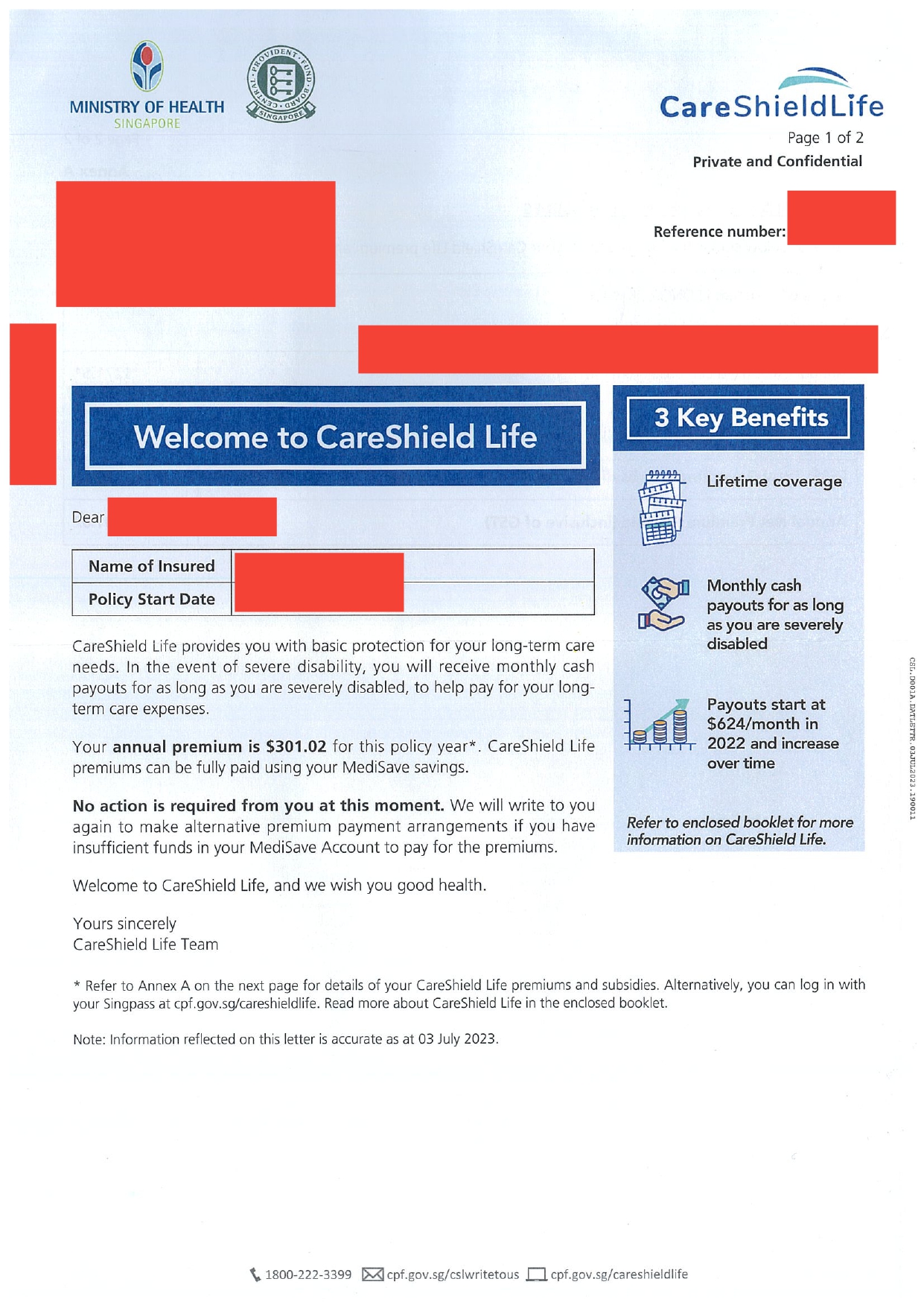
Official CareShield Life Document

Once you become a Permanent Resident (PR), you will automatically receive this official document from the CPF Board, enrolling you in CareShield Life.

  • Automatic enrollment for PRs born 1980 or later
  • Premiums payable via Medisave
  • Lifetime coverage for severe disability
Official CareShield Life Document from CPF Board
2

Why You Should Upgrade Your Coverage

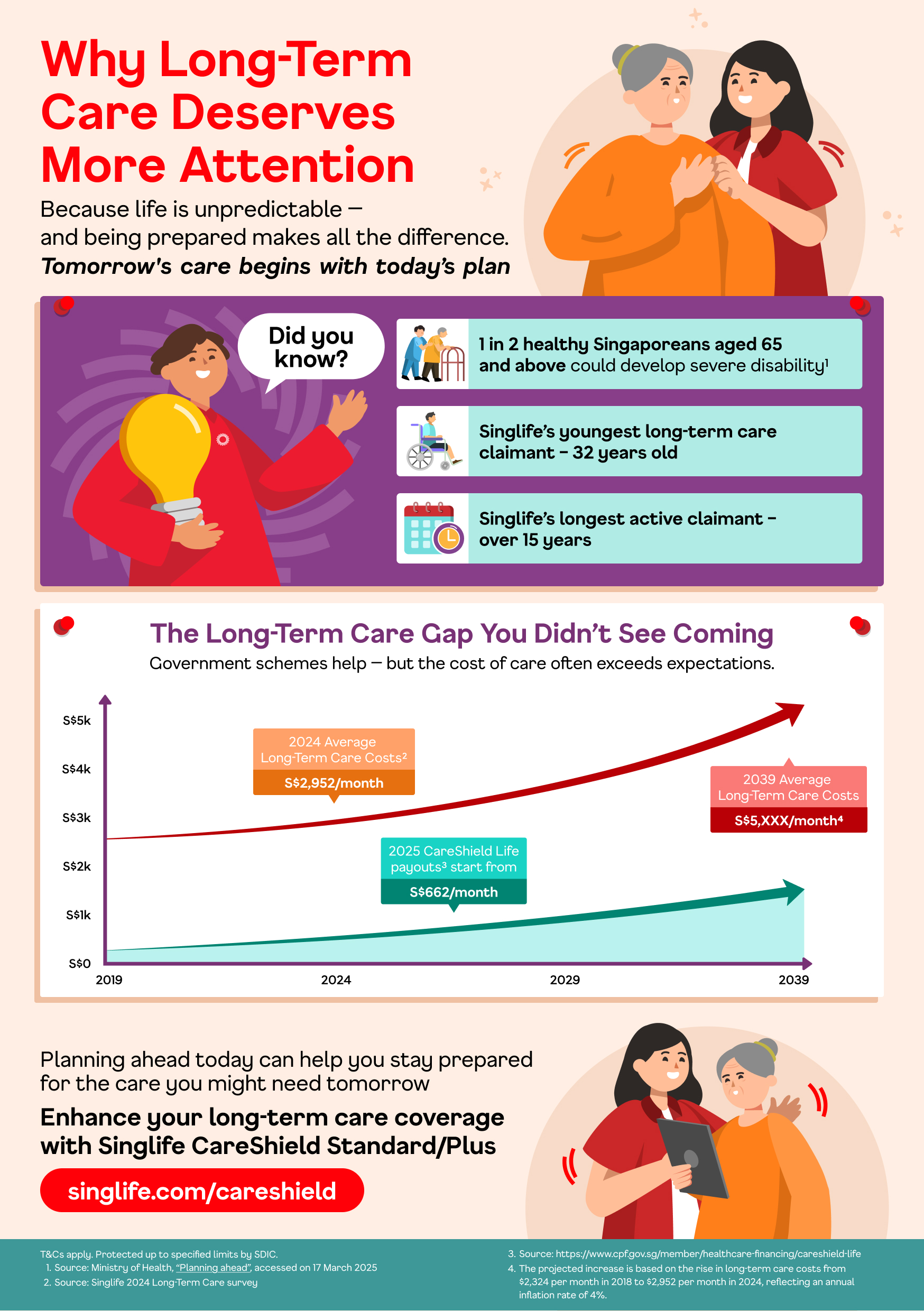
While CareShield Life provides basic protection, the $600/month payout may not be enough for quality long-term care. Here's why upgrading with a supplement makes sense:

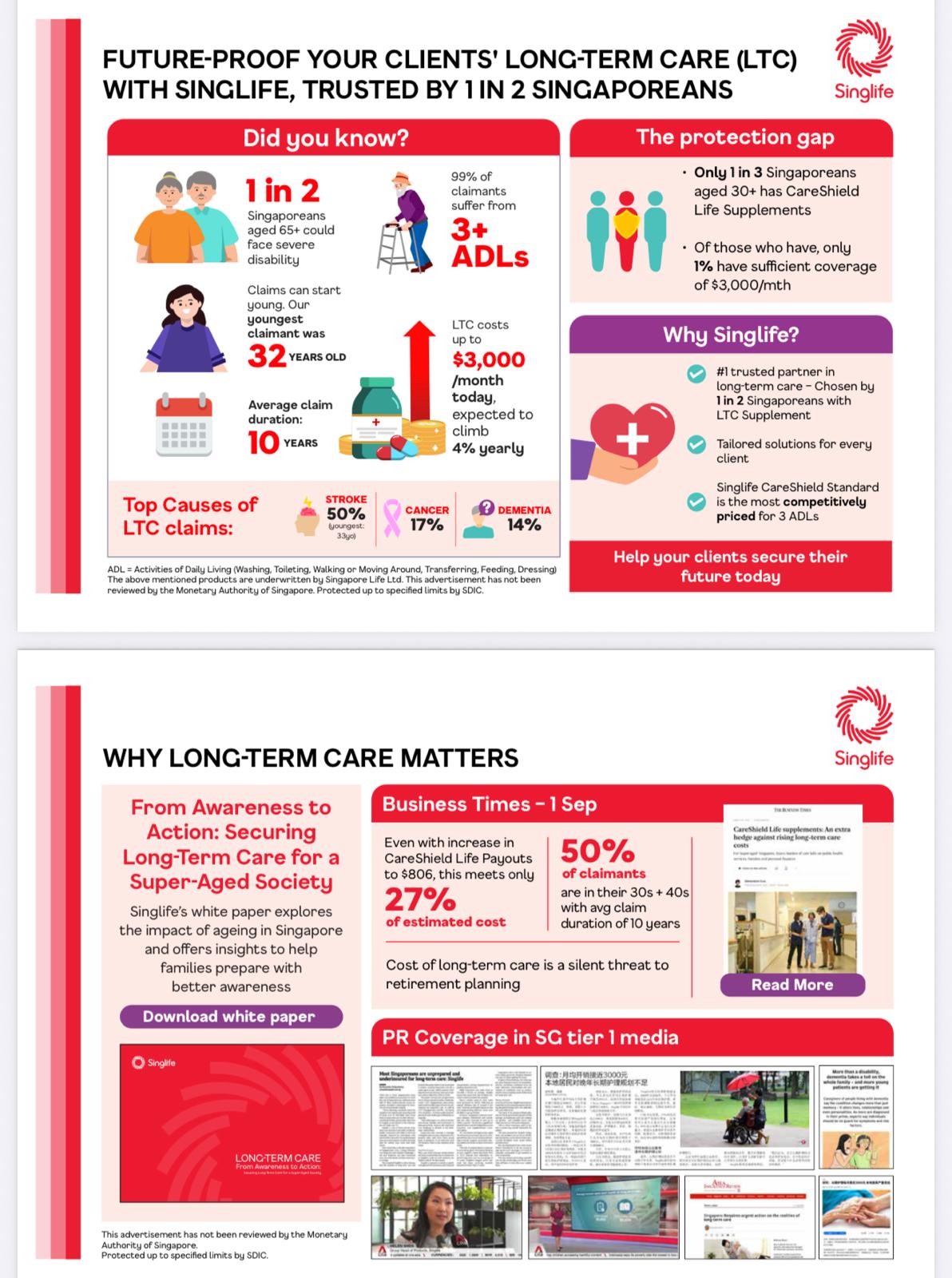
CareShield Life Whitepaper - Why It Matters
CareShield Life Whitepaper - Take Action Now
3

Take Action Now

💡

Pro Tip: The earlier you secure your CareShield Life supplement, the lower your premiums and the longer your coverage grows. Don't wait until it's too late. Lock in your rates while you're young and healthy.

Long-Term Care Options for Expats

💡

Pro Tip: Since CareShield Life is not available to foreigners, consider these private insurance options that can provide similar long-term care protection.

🛡️

Get Long-Term Care Coverage Now

Quick online application via Singlife Direct

Apply Online

Private Long-Term Care Insurance

Standalone plans that pay a monthly benefit if you cannot perform ADLs. Available from various insurers in Singapore and can be customized to your needs.

  • Monthly payouts up to SGD 5,000+
  • Lifetime or fixed term coverage
  • No citizenship requirement

Critical Illness with LTC Rider

Some critical illness plans include long-term care benefits as an add-on, providing comprehensive protection against both critical illnesses and disability.

  • Combined CI and LTC coverage
  • Lump sum + monthly payouts
  • Cost-effective bundling

International Health Plans

Some international health insurance plans include long-term care benefits or can be enhanced with nursing care coverage for global protection.

  • Global coverage
  • Portable when you relocate
  • Nursing home coverage options

Pro Tips for Expats

1

Plan for Your Retirement Location

Where will you retire? If you plan to stay in Singapore or move to a country with high healthcare costs, long-term care insurance becomes essential. If returning to a country with strong social safety nets, your needs may differ.

2

Consider Currency and Inflation

Long-term care costs increase with inflation. Choose plans that offer increasing payouts or consider the stability of SGD versus your home currency for wealth preservation purposes.

3

Don't Wait Until You're Older

Long-term care premiums increase significantly with age. Health conditions developed later in life may result in exclusions or declined applications. Starting early locks in better rates and coverage.

4

If You Become PR, Assess Your Options

If you're planning to convert to PR status, you'll become eligible for CareShield Life. However, you can also supplement with CareShield Life Supplements for enhanced coverage. Planning ahead ensures a smooth transition.

Frequently Asked Questions

Can foreigners buy CareShield Life?

No, CareShield Life is exclusively for Singapore Citizens and Permanent Residents. Foreigners on work passes cannot participate in this national scheme. However, there are private long-term care insurance options available from commercial insurers that provide similar or better protection.

What are Activities of Daily Living (ADLs)?

The 6 Activities of Daily Living (ADLs) are: Washing, Dressing, Feeding, Toileting, Walking, and Transferring (moving between bed and chair). For CareShield Life and most LTC policies, you must be unable to perform at least 3 of these 6 activities to qualify for payouts. This represents severe disability requiring ongoing care.

How much does long-term care cost in Singapore?

Nursing home care in Singapore ranges from SGD 1,500 to SGD 5,000+ per month depending on the level of care and facility type. Home care services can cost SGD 1,000 to SGD 3,000+ per month. With average life expectancy and potential years of care needed, the total cost can easily exceed SGD 200,000 to SGD 500,000 or more.

What if I become PR later?

When you become a Singapore Permanent Resident, you'll be automatically enrolled in CareShield Life if you're born in 1980 or later. You can then choose to supplement it with private CareShield Life Supplements (CSLS) for enhanced coverage. Any private LTC insurance you purchased as a foreigner can be maintained alongside CareShield Life for additional protection.

Plan Your Long-Term Care Protection

Don't leave your future to chance. Our advisors can help you understand your options and find the right long-term care solution for your situation.